Buffon’s Needle Problem
Estimate π by dropping needles on parallel lines (geometry + probability).
Part A — Variables & Randomness
-
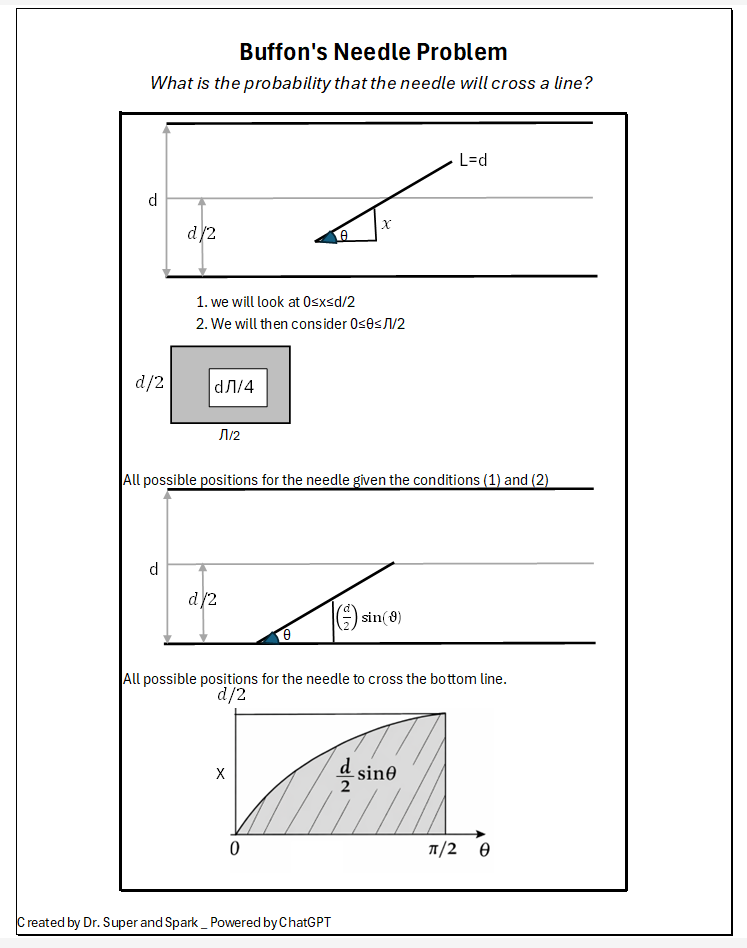
The the two random variables used in the problem (see image):
x = Vertical distance from the needle center to a parallel line going through the end of the needleθ = angle between needle and the lines
-
Give the ranges (use inequalities):
Part B — When does the needle cross a line?
The needle crosses a (nearest) line when the vertical “reach” from its center to an endpoint is at least x.
-
In the case L = d, the condition is:
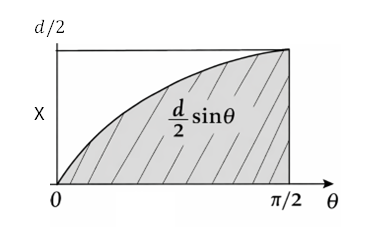
- The probability of crossing becomes an “area ratio” in the (θ, x) plane.
First youintegrate (find the area) from 0 to d/2sin(θ):
Then you integrate the result from θ=0 to π/2:
Area for Crossing drops = (d/2)[0-(-1)]=(d/2)[1]=d/2
Finally,To find the probability of crossing, you divide by the total area of the rectangle (d/2 * π/2):
Part C — Estimating π from data
Suppose you drop N needles and observe C crossings. Then P̂ = C/N and (for L = d) you can estimate:
Now you can plug in your own numbers for N and C to get an estimate for π:
For N=10000 change C to get as close as possible to π ≈ 3.14159...
Extension (optional)
In general, if L ≠ d, the probability changes. When L ≤ d, the famous formula is: P(cross) = (2L)/(πd).
Challenge: If you double the needle length, what happens to the probability? Explain in one sentence.
Dr. Super & Spark Math and Science Series – Powered by ChatGPT