🔊 Listen to the story
Click Read to hear the story aloud. You can pause or stop at any time.
 Richard Feynman
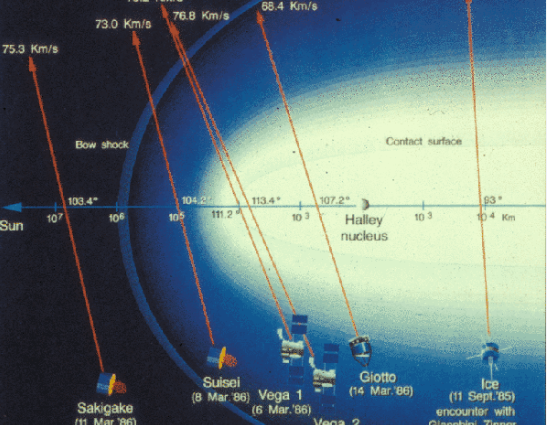 Halley Armada - 5 Probes
 George Gamow
The Feynman–Gamow Deep-Space Mission
Two Legendary Physicists, One Comet, and a Race Against Interference
In 2061, Halley’s Comet sweeps past Earth for the first time since 1986. NASA prepares a daring mission: launch two coordinated deep-space probes to intercept the comet and study it up close as it races through the inner solar system. To honor two of the greatest physicists of the 20th century, the probes are named after:
Richard Feynman (1918–1988) A Nobel Prize–winning physicist known for his brilliant imagination, playful personality, and ability to explain deep ideas with simple pictures. Feynman transformed quantum mechanics, helped uncover the cause of the Challenger disaster, and inspired generations with his joy for discovery. The Feynman Probe carries a quantum telescope, the most sensitive instrument ever flown near a comet. It can detect microscopic dust and plasma streams trailing behind Halley’s nucleus.
George Gamow (1904–1968) A physicist with enormous creativity who helped explain radioactive decay, pioneered early ideas about black holes, and first predicted the cosmic microwave background—the leftover glow of the Big Bang. He also wrote imaginative science books that made hard ideas fun. The Gamow Probe carries the mission’s communication and navigation systems, sending powerful signals back to Earth to steer both spacecraft during their high-speed encounter with the comet.
The Problem NASA Discovered Because the probes travel along similar paths, NASA engineers found a serious issue: If the Feynman Probe ever becomes less than twice as far from Earth as the Gamow Probe, the radio signals from Gamow can interfere with Feynman’s delicate quantum measurements. To protect the telescope, the mission must obey a strict separation rule: The Feynman–Gamow distance ratio must approach 2 but never go below 2.
So engineers design the propulsion systems carefully: The Feynman Probe receives a long-range ion engine with more sustained acceleration than the Gamow Probe. The Gamow Probe accelerates more gently but communicates more strongly. Both probes launch together on July 28, 2061, beginning their chase toward Halley’s blazing tail. But even with careful engine design, Mission Control needs to know: Could Gamow’s signals drift too close and contaminate Feynman’s telescope?
To see if the ratio truly approaches 2 and stays above 2 for the entire mission, you will analyze their motion using DiVA: Distance → Velocity → Acceleration charts using L’Hôpital’s Rule that should reveal whether the mission is safe or not?