🔊 Listen to the story
Click Read to hear the story aloud. You can pause or stop at any time.

The Cannonball and the Moment that Changed Motion
In the early 1600s, European battlefields thundered with cannons. Iron balls flew through smoke-filled skies — powerful, dangerous, and wildly unpredictable. Gunners aimed, fired, and hoped. No one could say where a cannonball would land or why. Yet every shot revealed the same quiet mystery. The cannonball always rose, slowed, paused for the briefest instant — and then fell. That pause changed science forever.
From Battlefields to Questions
In Italy, a young mathematician named Galileo Galilei watched cannonballs and falling stones with a new kind of curiosity. Instead of asking where they landed, he asked: How does motion change from moment to moment? Galileo realized that guessing was useless. Motion had to be measured. He focused on one direction at a time — especially up and down.
The Vertical Secret
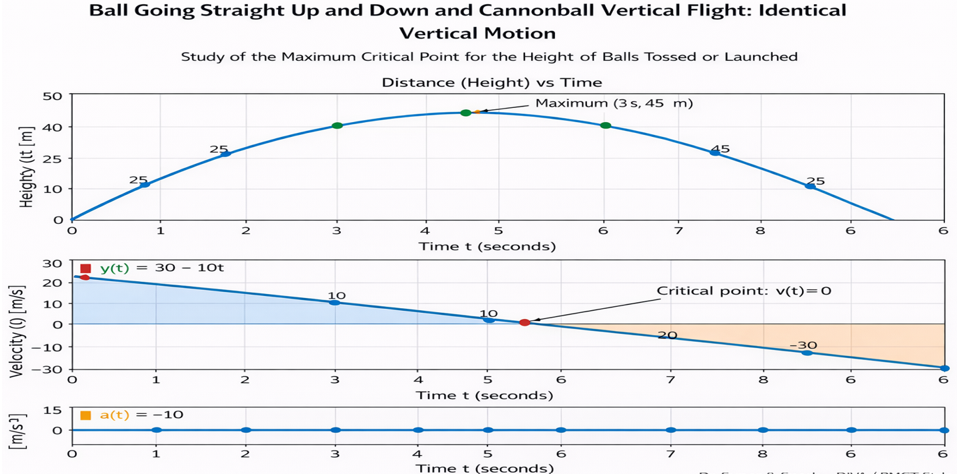
The instant a cannonball leaves the cannon, gravity begins pulling it downward. Every second: the upward velocity decreases by the same amount; the ball slows smoothly; until, at one exact moment, the upward motion reaches zero. At that instant, the cannonball is higher than it will ever be. This moment is not luck. It is inevitable.
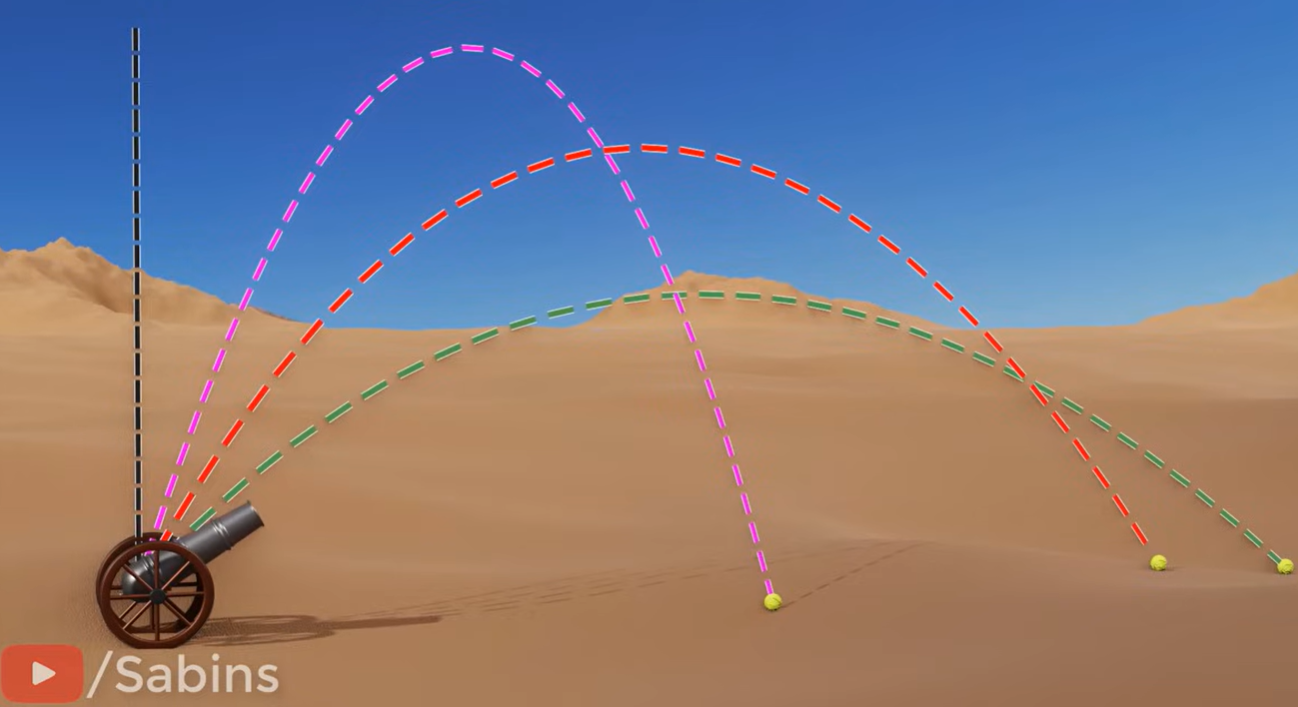
If a ball is thrown straight up with the same vertical speed that the cannonball has when it leaves the cannon, then both objects follow exactly the same vertical motion. They rise for the same amount of time, reach the same maximum height, pause, and fall back to the ground in the same way. The cannonball may travel forward across the sky, but vertically, it behaves no differently than a ball tossed straight up by hand.
Newton Finds the Peak
A generation later, in England, Isaac Newton gave this moment a name and a language. Height, Newton showed, is a function of time. Velocity is the slope of that height. Acceleration is what changes the slope. When velocity becomes zero, the slope flattens. That flat point is the maximum — the top of the curve — what we now call a critical point.
Why This Changed the World
Once this idea was understood, cannons stopped being guesses. Engineers could finally predict how high a ball would rise; when it would stop climbing; how far it would travel. The same mathematics now guides rockets, satellites, and space probes. It governs basketball shots, golf swings, and planetary motion. Every arc in the sky carries the same hidden structure.
The Big Idea
The most important moment in motion is not when something moves the fastest. It is the instant when change pauses. That pause is where calculus lives. And that is why, on your DiVA charts, the highest point of the height curve lines up exactly with the zero of the velocity curve.
div>