🧠 Adventure 15 – Activity 2 Solution
Pattern finding across the Solar System
This page gives concise teacher-facing answers to the Activity 2 questions.
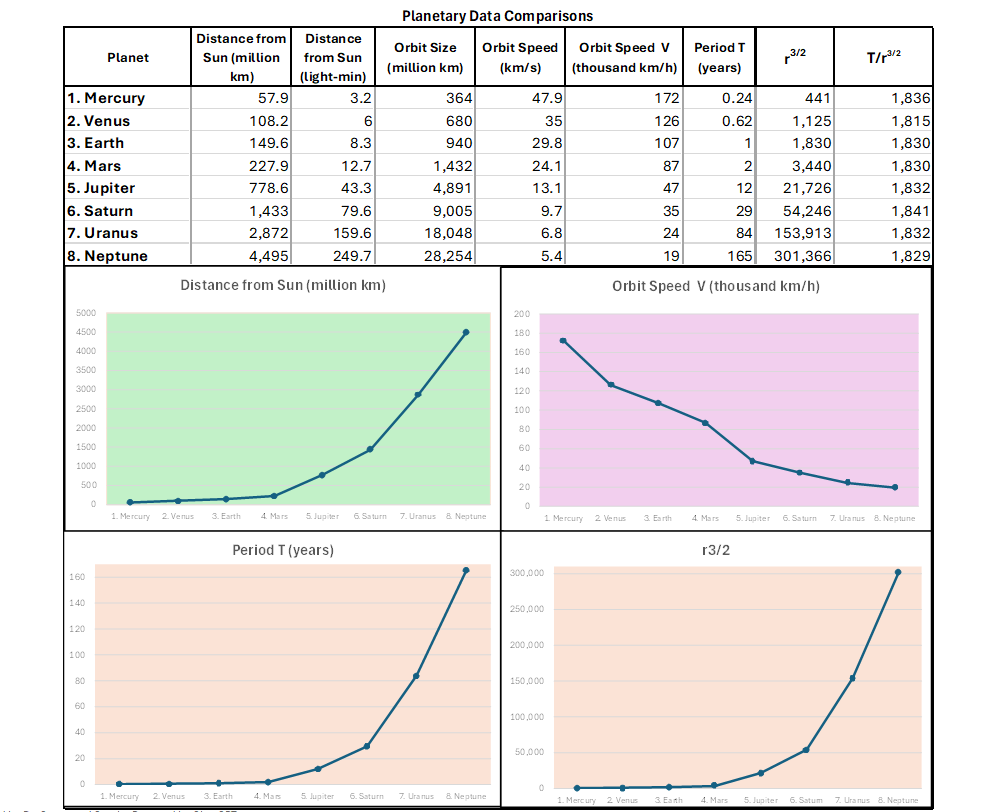
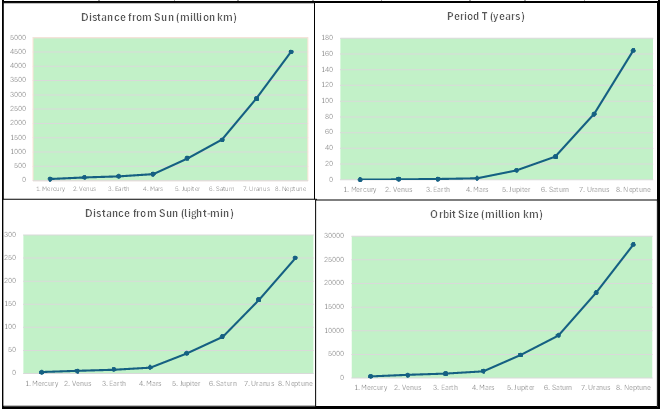
📊 Planetary Data Charts and Tables
Use these charts together with the table to explain the big Solar System patterns: orbital speed decreases with distance, while orbit size and orbital period increase.
The last two questions connect these visual patterns to Kepler’s third law and the formulas for orbital speed and orbital period.
✅ Suggested Answers
1. As distance from the Sun increases, orbital speed decreases. Planets farther away move more slowly because the Sun’s gravitational pull is weaker at larger distances.
2. As distance from the Sun increases, orbit size increases and orbital period increases strongly. Outer planets travel much longer paths and take much longer to complete one orbit.
3. Period T is approximately proportional to r^(3/2). Equivalently, T² is proportional to r³.
4. Since v = √(GM/r) and T = 2πr / v, substituting gives T = 2π √(r³ / GM). Squaring both sides gives T² = (4π² / GM) r³.
5. Possible observations: inner planets are close together and move quickly; outer planets are far apart and move slowly; a small increase in orbital radius produces a much larger increase in orbital period.