🔊 Listen to the story
Click Read to hear the story aloud. You can pause or stop at any time.
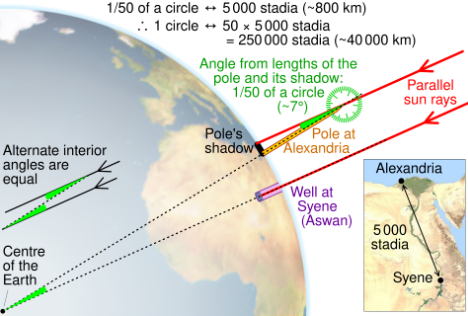 Measure of Earth's circumference, based on the approximation that Syene is on the Tropic of Cancer and on the same meridian as Alexandria
Measuring the World by Slices and Sticks
(Inspired by Bill Bryson’s chapter on early attempts to measure Earth)
Long before satellites and laser measuring tools, no one knew how big the Earth was. People guessed, argued, and made wildly different claims. Some thought the planet was enormous; others believed it was much smaller. What they all agreed on was this: the Earth was far too large to measure directly.
Then came Eratosthenes. He lived more than two thousand years ago and worked in the Great Library of Alexandria — a place filled with scrolls, scholars, and a great deal of sunshine. Eratosthenes had learned something curious: in a southern city called Syene, the sun shone straight down a well on the summer solstice. At the very same moment in Alexandria, a vertical stick cast a small shadow.
This tiny difference — the angle of a single shadow — was the clue.
Eratosthenes realized he could “slice” the Earth using shadows the same way we slice area under a line: by taking a simple measurement and using it to understand something much bigger.
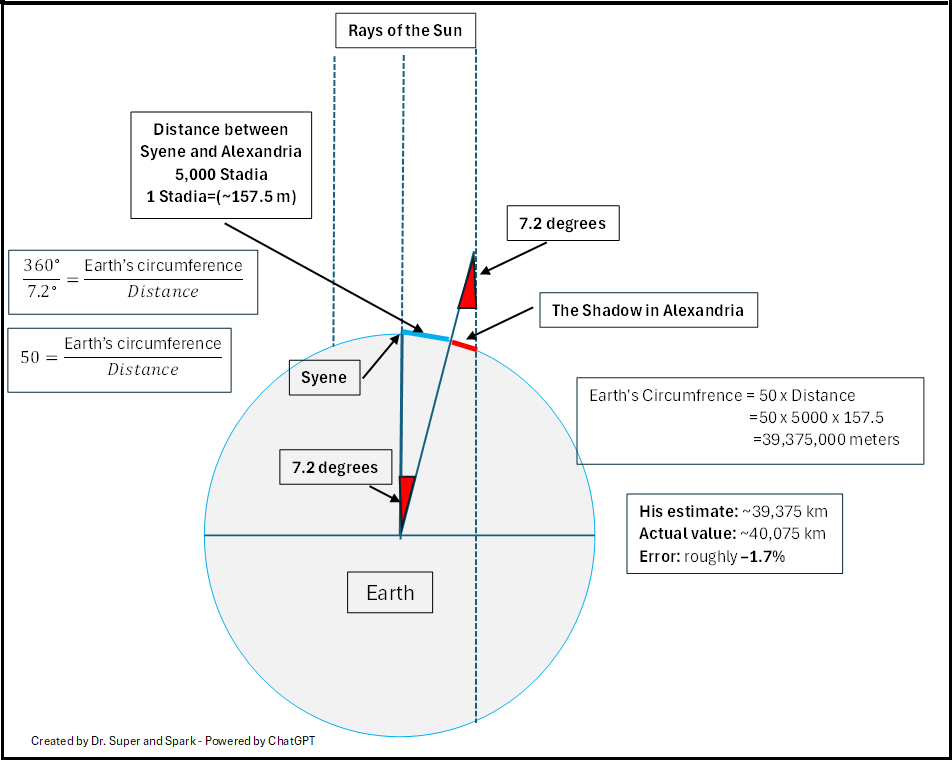
He measured the angle of the shadow in Alexandria (about 7 degrees), knew the distance between the two cities, and reasoned: “If 7 degrees of curvature corresponds to this many miles, then the whole 360 degrees must correspond to… the entire Earth.”
In other words, he used a small piece — one slice — to understand the whole curve of the planet.
His method was astonishingly accurate, less than 2% error as compared to modern measurements.