✏️ Adventure 4 — Activity
Use the charts to connect height, velocity, and acceleration — and discover why
calculus is really “slope + area”.
Assumptions: no air resistance • constant acceleration downward g=10 m/s² • time ticks every 1 second.
✳ Equations (given)
y(t) = 980 − ½ g t²v(t) = y′(t)a(t) = v′(t)
1) Height vs Time (Read the graph)
2) Velocity and Distance (Area under v(t))
3) Hitting the Ground
4) Acceleration Check (Area under a(t))
★ Calculus Challenge (Show your work)
- Differentiate
y(t)to findv(t). Differentiate again to finda(t). - Could you recover
v(t)andy(t)by integratinga(t)andv(t)? Explain briefly.
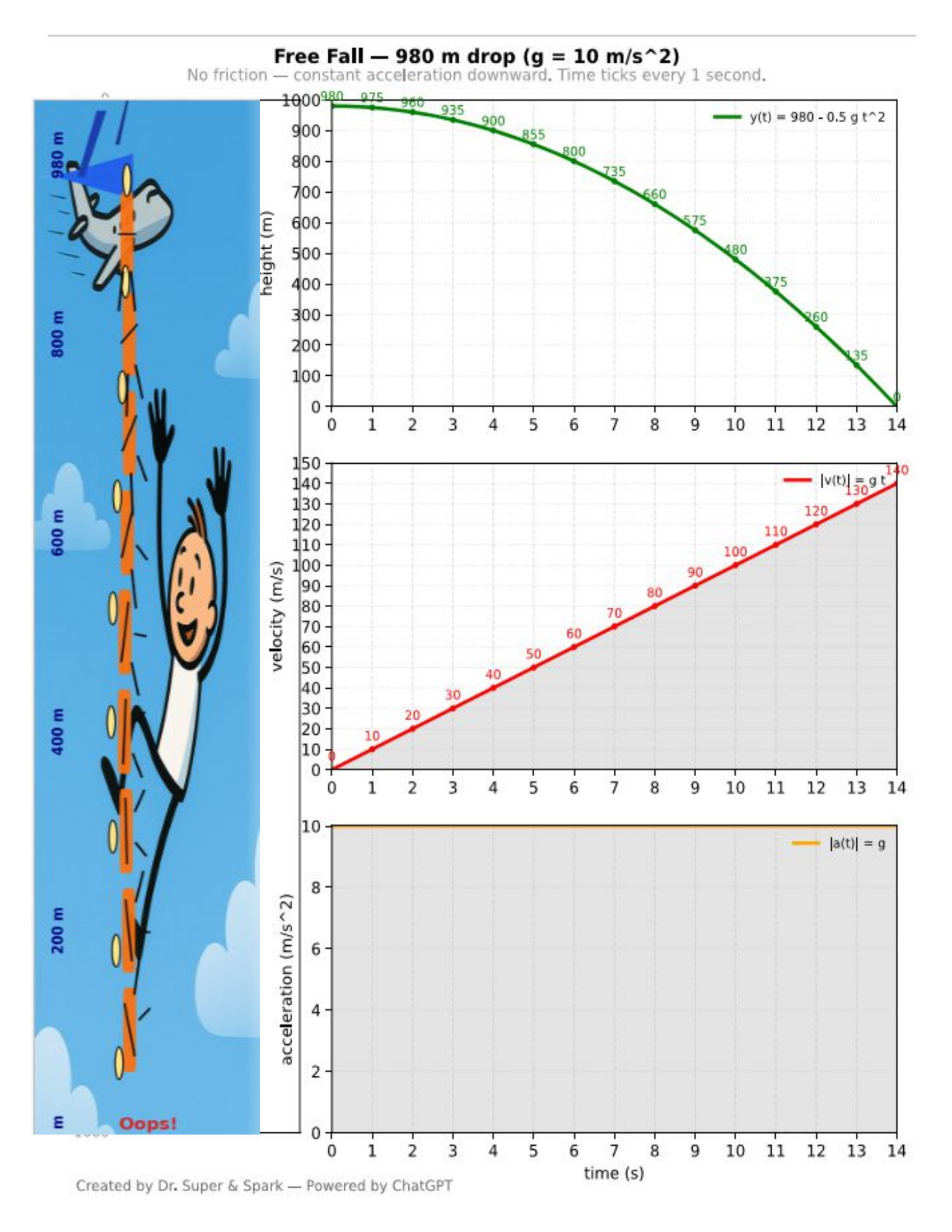
Use the charts. Remember: area under v(t) gives distance fallen, and area under a(t) gives change in velocity.
For unit conversion: km/h = (m/s) × 3.6.
Sample solution (g = 10 m/s²)
- y(4)=900 m, y(10)=480 m, distance from 4→10 is 420 m
- Area under v(t): 0→4 is 80 m, 0→10 is 500 m (matches distance fallen)
- Impact: t=14 s, speed = 140 m/s = 504 km/h
- Area under a(t) from 4→10: 60 m/s, which equals Δv