🔊 Listen to the story
Click Read to hear the story aloud. You can pause or stop at any time.
The Apple, the Bet, and the Book
Long ago in England, a quiet young man named Isaac Newton loved thinking more than talking. When the plague closed London’s universities, he went home to the countryside. There, sitting beneath an apple tree, he began wondering why an apple always fell straight down—never sideways or up. He realized the same invisible pull that brought the apple to the ground must also hold the Moon in its path around Earth.
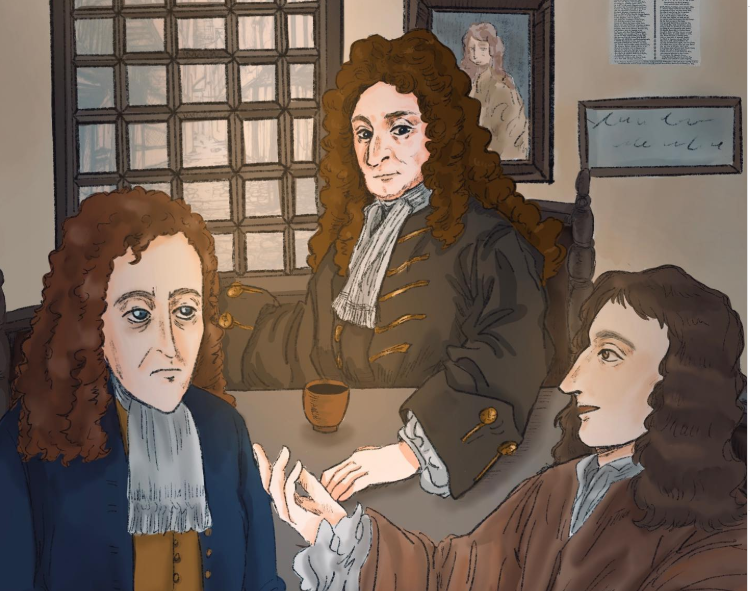
Years later three brilliant friends—Sir Christopher Wren, Robert Hooke, and Edmond Halley—were arguing about what kind of curve a planet follows around the Sun. Wren, always mischievous, offered a bet: “A golden cup to whoever can prove the path of the planets!”. Hooke bragged that he knew the answer but did not want to spoil the bet. Halley, curious and determined, rode all the way to Cambridge to ask Newton. When he said, “What shape would the orbit be if gravity pulls as the inverse square of distance?” Newton quietly replied, “An ellipse, of course—I worked it out years ago.”
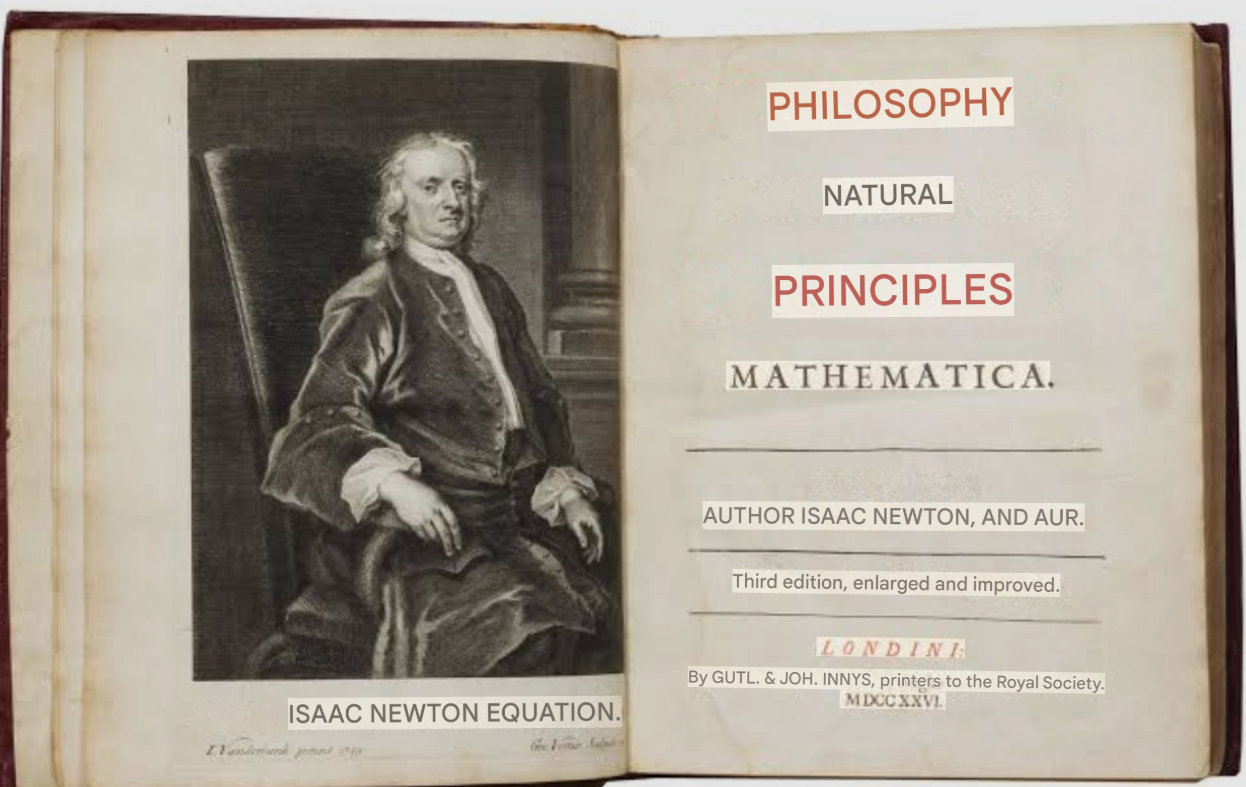
Halley was stunned. He begged Newton to find his papers. When Newton couldn’t, he rewrote everything from scratch—tying the heavens and the Earth together. The result was a great book: Philosophiæ Naturalis Principia Mathematica (The Principia).
It showed that the same simple rules describe falling apples and whirling planets. In developing these ideas, Newton also invented calculus—the powerful mathematical language needed to describe motion and change. He formulated his three laws of motion and the universal law of gravitation, revealing that the same force pulling an apple to Earth also governs the motion of the Moon and planets. Halley even paid to publish it, and Newton’s work transformed our view of the universe—from a place of mystery and speculation into one governed by precise, testable laws—making physics truly scientific for the first time.
Moral
Sometimes one person’s curiosity, one friend’s encouragement, and one friendly bet can move the heavens themselves.