🏁 Adventure 5 — Activity
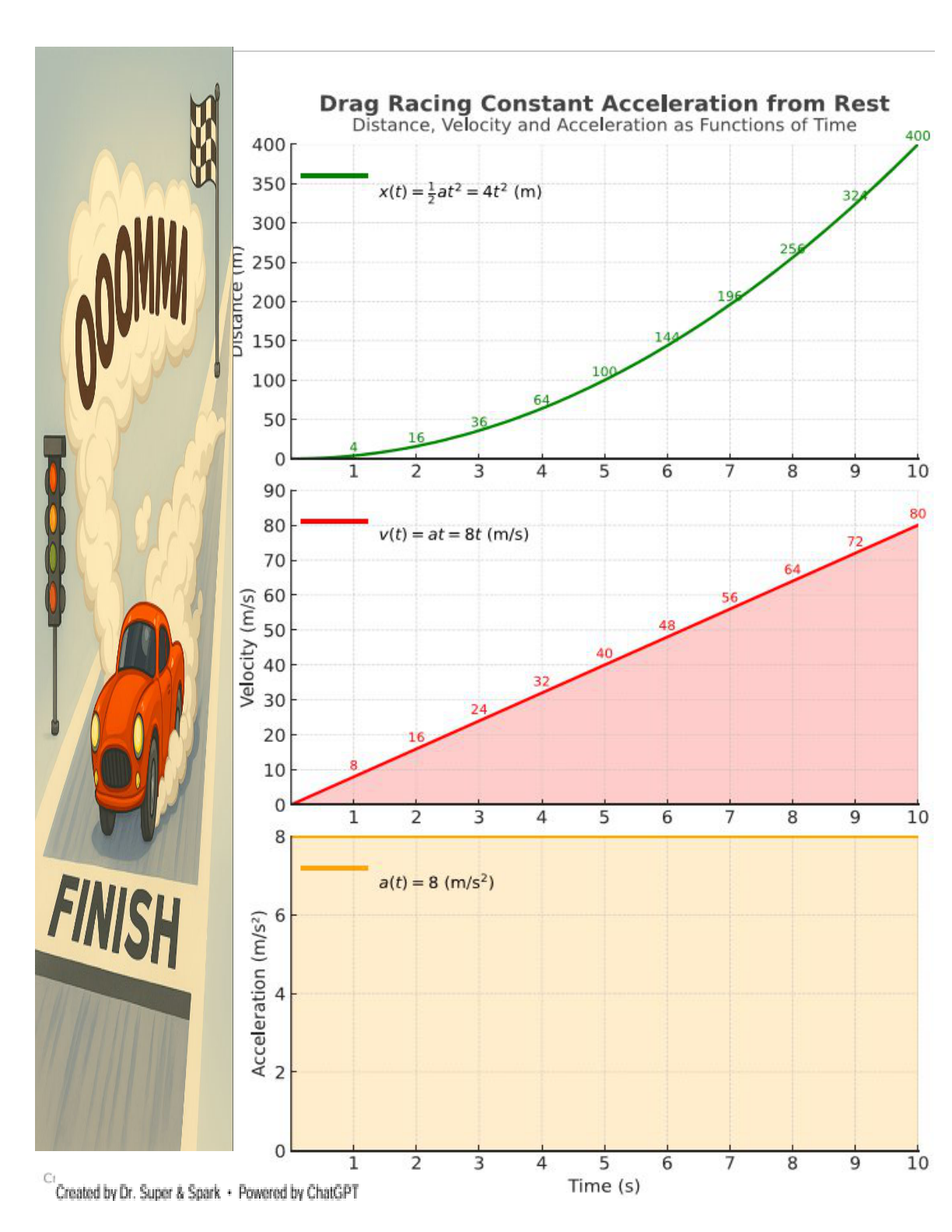
Use the charts to connect distance, velocity, and acceleration — and discover why calculus is really “slope + area”.
Assumptions: no friction • constant acceleration from rest • time ticks every 1 second.
✳ Equations (given)
a(t) = 8(constant, m/s²)v(t) = a·tx(t) = ½·a·t²
1) How far, how fast? (Read the graphs)
2) Area means distance (Area under v(t))
3) Slope means velocity (Tangent line idea)
4) Finish line (¼ mile = 400 m)
5) Acceleration check (Area under a(t))
6) (***) Calculus
- Differentiate
x(t)to getv(t), then differentiatev(t)to geta(t). - Integrate
a(t)to recoverv(t), and integratev(t)to recoverx(t).
7) (***) Kinetic Energy and Work
Fill the table to verify for m=1,000 kg KE = ½ m v² (j) matches Work = F·d (j) (F=ma for constant acceleration). Will this be true for any m?
| Time (s) | Velocity (m/s) | Distance (m) | KE (kJ) | Work (kJ) |
|---|---|---|---|---|
| 2 | ||||
| 5 | ||||
| 10 |
Tips: For triangles, area = ½·base·height. For unit conversion: km/h = (m/s) × 3.6.
Remember: area under v(t) gives distance, and area under a(t) gives change in velocity.
Remember: area under v(t) gives distance, and area under a(t) gives change in velocity.