🔊 Listen to the story
Click Read to hear the story aloud. You can pause or stop at any time.
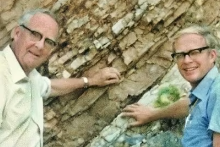 Walter and Luis Alvarez at Gubbio Italy - Big History on You Tube
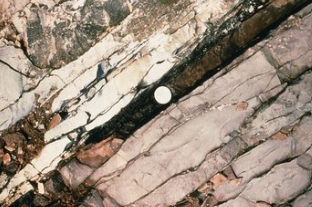 the Bottaccione Gorge outcrop showing the cliff face where the K–Pg boundary layer is exposed.
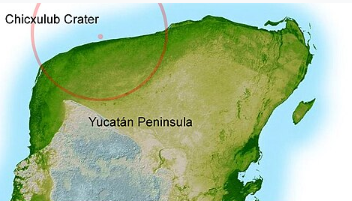 Chicxulub crater - 66 million years ago when an asteroid, about ten kilometers in diameter, struck Earth.
The Layer That Changed the World - The Extinction of Dinosaurs
The Dinosaur Extinction, the Missing Crater, and the DiVA Charts
In 1980, a young geologist named Walter Alvarez was climbing the limestone cliffs of Gubbio, Italy, when he noticed something odd: a very thin, chocolate-brown band of clay—only a couple of centimeters thick—squeezed between massive layers of limestone. It looked ordinary, but Walter’s instincts said otherwise. He scraped a sample and took it home.
Walter’s father, Luis Alvarez, a world-famous physicist and Nobel Prize winner, used to tease him: “Geology? That’s not real science. That’s just collecting rocks.” But he respected curiosity—especially Walter’s. So when he saw the strange clay, Luis contacted his colleague Frank Asaro, a nuclear chemist with one of the most advanced neutron-activation systems in the world. Asaro analyzed the sample using equipment normally reserved for high-precision physics.
The results were stunning: the clay contained an enormous spike of iridium—hundreds of times more than Earth’s crust normally has. Iridium is extremely rare on Earth but common in asteroids.
Then came the breakthrough. Geologists began reporting the same thin layer in Denmark, Spain, New Zealand, Egypt, North America, and even deep-sea drill cores. A global stripe of iridium-rich clay, laid down everywhere at the same moment—the instant the dinosaurs vanished.
Walter, Luis, Asaro, and others pieced together the story: a six-mile-wide asteroid had slammed into Earth. Dust from the explosion, rich in iridium, circled the globe and settled into a slender stripe of clay—thin as a coin, yet recording one of history’s greatest catastrophes.
One mystery remained: Where was the crater? For years, no one could find it. Then petroleum geologists in Mexico mapped unusual gravity readings under the Yucatán Peninsula. Their data revealed a buried circular scar, 110 miles wide. The Chicxulub crater—exactly the right age—had finally been found. The last missing piece clicked into place. And Luis Alvarez never again joked about Walter’s “rock collecting.”
Beginning in the 1960s, Patterson examined these records and found a dramatic jump in atmospheric lead starting around 1927—the exact year tetra-ethyl lead was introduced into gasoline. Patterson used these results extensively to fight the big oil companies and get the Lead out of Gasoline. After the Clean Air Act, ice cores showed lead levels dropping just as quickly.
The DiVA Chart: Motion’s Iridium Layer
Just as the thin iridium layer reveals Earth’s past, motion leaves behind its own thin stripe that reveals how something moved. A vertical stack of three curves: Distance; Velocity; Acceleration.
Together they form the DiVA Chart—the Distance–Velocity–Acceleration layer. The name DiVA echoes the ancient Indo-Iranian word Deva, meaning “shining one, guiding light.” In later Persian tradition the same root became Div, a creature of chaos—reflecting a deep cultural inversion during Mithraic and proto-Zoroastrian transformations.Together they form the DiVA Chart—the Distance–Velocity–Acceleration layer. The name DiVA echoes the ancient Indo-Iranian word Deva, meaning “shining one, guiding light.” In later Persian tradition the same root became Div, a creature of chaos—reflecting a deep cultural inversion during Mithraic and proto-Zoroastrian transformations.
Motion behaves the same way: when understood, it is elegant and clear like a Deva; when misunderstood, it feels chaotic like a Div. The DiVA Chart is the guiding light that makes motion readable.Just as geologists learned to read Earth’s past from a thin band of clay, you will learn to read motion from this thin band of calculus.