✏️ Adventure 3 — Activity
Your goal: use geometry to compute
df(x), then find df(x)/dx.
Keep dx as a tiny number, and remember: terms with dx or dx² or dx³ vanish as dx → 0.
Tip: Think “new pieces only.” The area/volume of the original blue square/cube is already x² or x³.
Only calculate what gets added when each side grows from x to x + dx.
Part A — Growing a Square: f(x)=x²
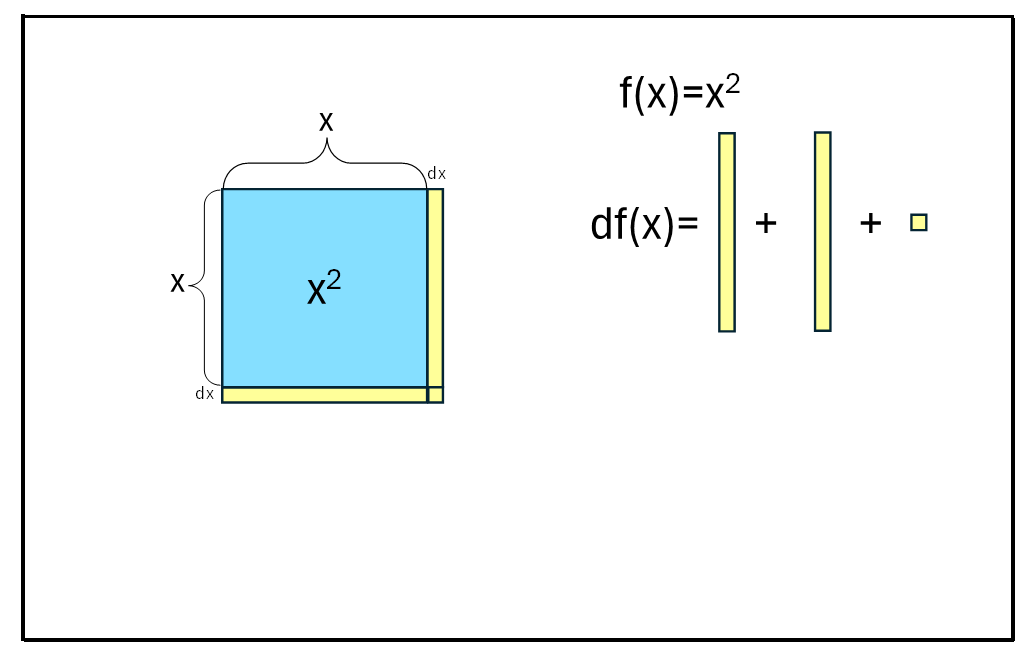
- Write the area of each new piece:
Vertical strip area =Horizontal strip area =Corner square area =
- Add them to find
df(x):df(x) = - Simplify:
df(x) = - Divide by
dx:df(x)/dx = - Now let
dx → 0. Cross out any terms that vanish and write the derivative:Derivative:d(x²)/dx =
Part B — Growing a Cube: f(x)=x³
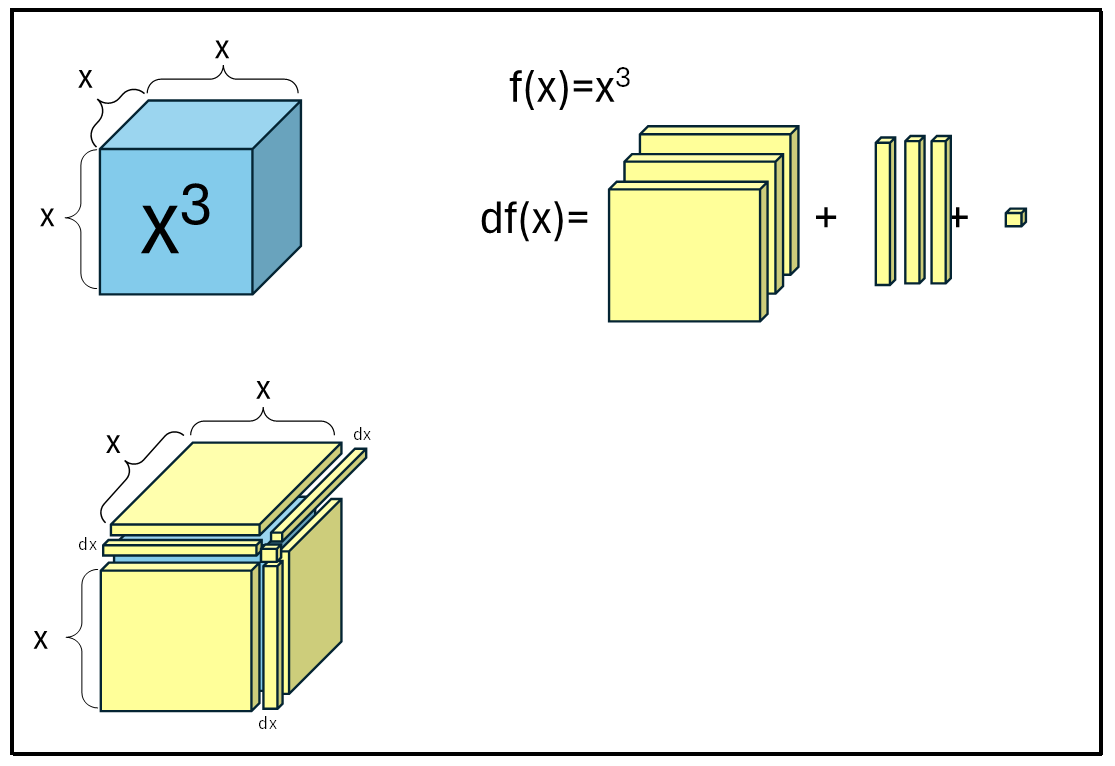
- Find the total volume of the new pieces that appear when the sides of a this cube grows from
xtox+dx:- Total volume of large face "sheets" each of volume
x²·dx? - Total volume of edge "bars" each of volume
x·dx²? - Total volume of tiny corner cube of volume
dx³?
- Total volume of large face "sheets" each of volume
- Add them to find
df(x):df(x) = - Factor out
dx:df(x) = - Divide by
dx:df(x)/dx = - Now let
dx → 0. Cross out vanishing terms and write the derivative:Derivative:d(x³)/dx =
Check: your final answers should be 2x and 3x².