✅ Adventure 7 — Solutions
Filled tables and sample explanations. Use these to check your work.
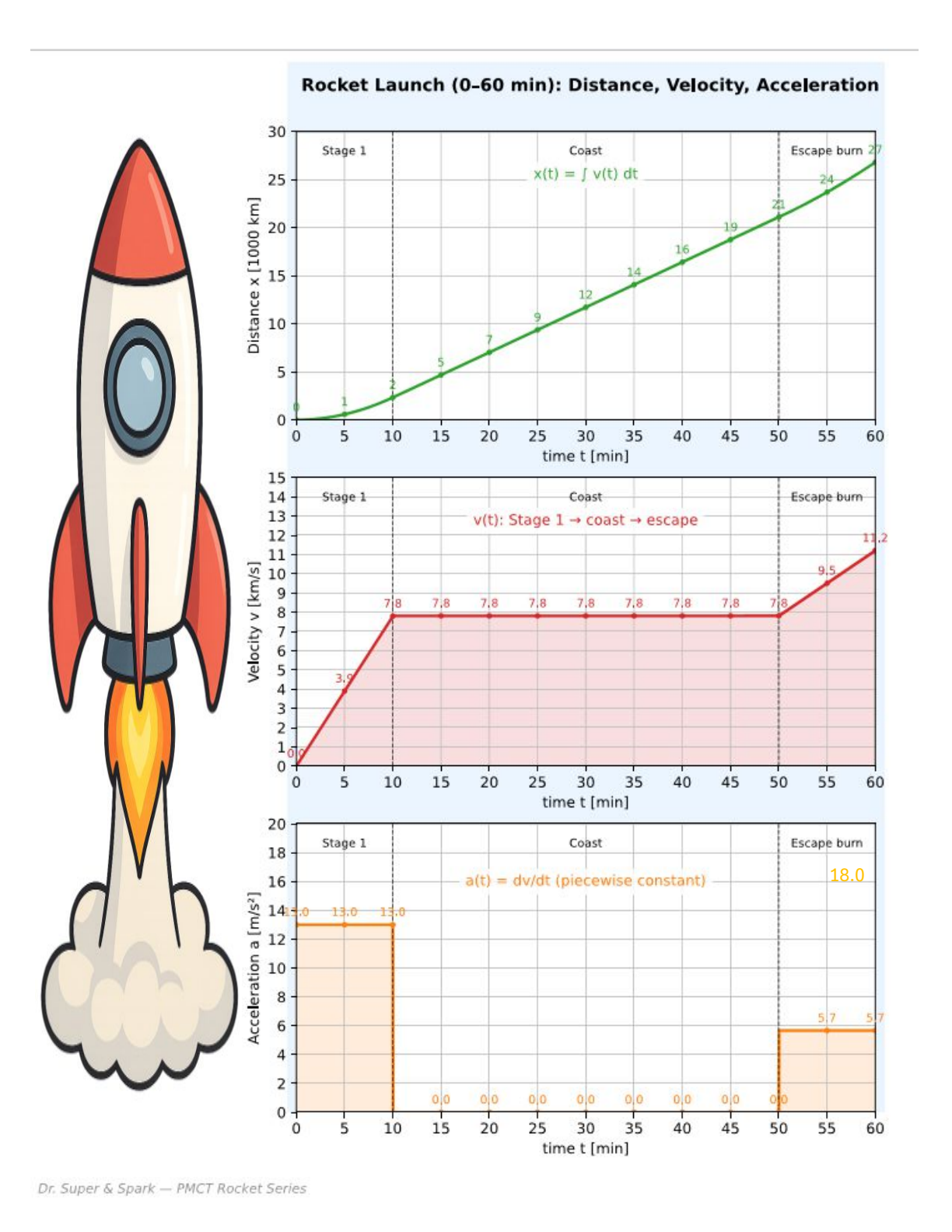
1) Velocity estimates and chart values
- t=5: slope ≈ 3.3 km/s, chart 3.9 km/s → 3900 m/s
- t=30: slope ≈ 7.9 km/s, chart 7.8 km/s → 7800 m/s
- t=58: slope ≈ 10 km/s, chart 11 km/s → 11000 m/s
2) Acceleration (slope of velocity)
- t=5: 13 m/s² (matches chart)
- t=30: 0 m/s² (matches chart)
- t=58: 5.66 m/s² (matches chart)
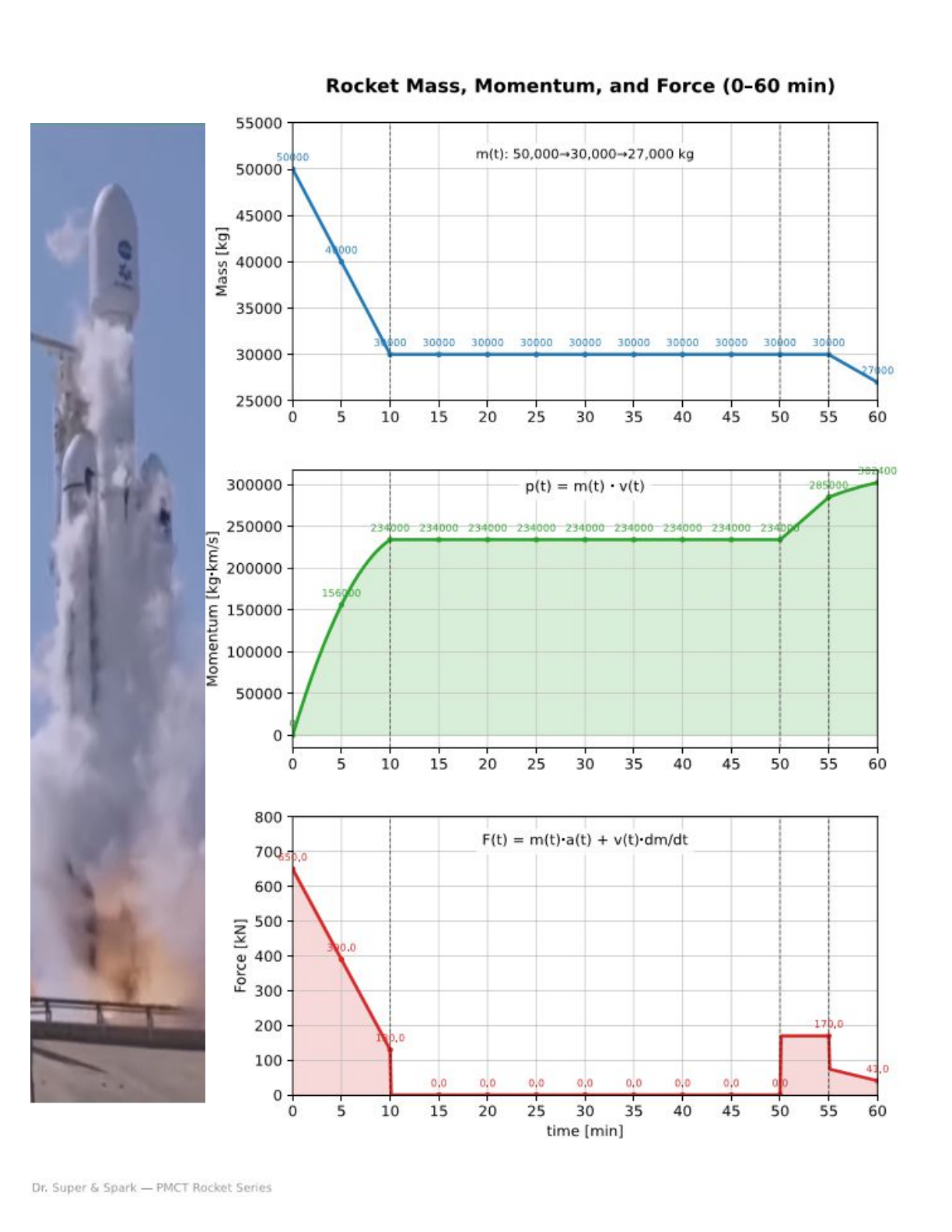
3) Mass from m(t)
- m(5)= 50,000 − 2,000·5 = 40,000 kg
- m(30)= 30,000 kg
- m(58)= 30,000 − 600(58−55) = 27,000 kg
4) Mass change m′(t)
- t=5: m′ = −2000 kg/min = 33.3 kg/s
- t=30: m′ = 0
- t=58: m′ = −600 kg/min = 10 kg/s
5) Force
- t=5: m·a = 520,000 N; v·m′ = 129,870 N; F ≈ 390,130 N
- t=30: F ≈ 0
- t=58: m·a = 152,820 N; v·m′ = 110,000 N; F ≈ 42,820 N
Interpretation (sample answers)
- Force is largest at launch because acceleration and fuel burn are both large.
- Force is near zero while coasting because a≈0 and m′=0.
- Force increases near 58 min because the rocket starts another burn (escape burn).
(***) Why acceleration can be exact but velocity slope is not
The velocity curve is piecewise linear, so its slope (acceleration) is constant on each stage, making rise/run exact. The distance curve is curved, so rise/run gives an average slope over an interval, not the instantaneous slope.
What makes the rocket go forward?
Fuel is ejected backward; the reaction pushes the rocket forward (and the rocket becomes lighter as it burns fuel).