🔊 Listen to the story
Click Read to hear the story aloud. You can pause or stop at any time.
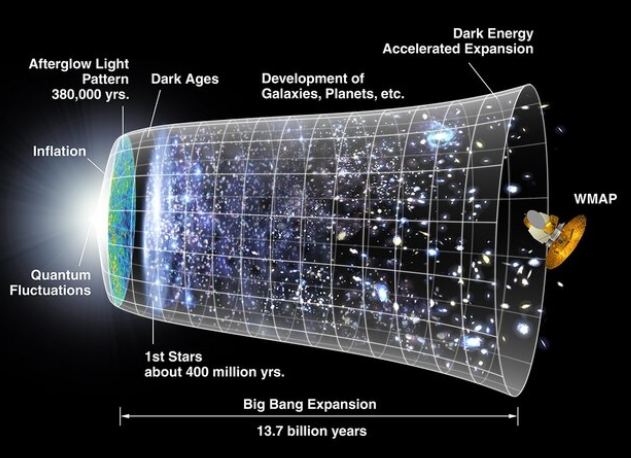 Timeline and expansion of the universe
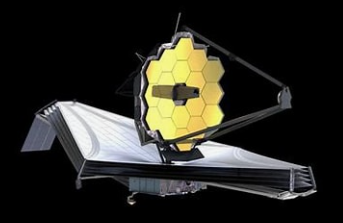 James Webb Space Telescope (JWST) - 2021 to present
A Short History of Stargazing and Space Travel
From Ancient Wonder to Modern Rockets and the Edge of Time
For thousands of years, people looked up at the night sky and believed they were seeing the stars exactly as they were in that moment. They drew constellations, told stories, predicted seasons, and navigated oceans by those tiny lights. The sky felt eternal and unchanging.
What ancient people didn’t know is one of the most astonishing ideas in science: when we look at the stars, we are looking into the past. Light takes time to travel. A star 100 light-years away shows us what it looked like 100 years ago. A galaxy a million light-years away shows us a million years into the past.
The results were stunning: the clay contained an enormous spike of iridium—hundreds of times more than Earth’s crust normally has. Iridium is extremely rare on Earth but common in asteroids.
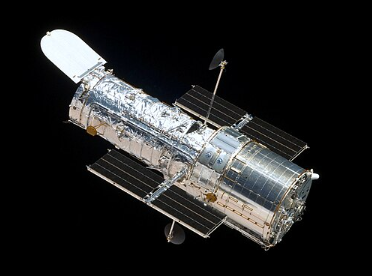
Only in the last century have we built tools powerful enough to truly understand this. The Hubble Space Telescope revealed galaxies so far away that their light began its journey when dinosaurs walked the Earth. And today, the James Webb Space Telescope can see even farther — capturing light from the first galaxies that formed after the Big Bang. Seeing the early universe is a modern superpower that didn’t exist for 99.99% of human history.
A thousand years ago, Persian scholars were among the world’s best observers of the sky. Astronomers like Omar Khayyam measured the Sun’s motion so precisely that the Jalali Calendar he helped design remains one of the most accurate calendars ever created. Their observations helped transform the sky from myth into mathematics.
Fast forward to the 20th century: rockets finally carried us closer to the stars. Before humans flew, scientists sent animals — monkeys, dogs, and chimpanzees — to learn how living bodies react in space. Then, in 1961, Yuri Gagarin became the first human to orbit Earth, calling out, “I see Earth… it is beautiful.” After that the space race started and eight years later, humans walked on the Moon for the very first time.
Beginning in the 1960s, Patterson examined these records and found a dramatic jump in atmospheric lead starting around 1927—the exact year tetra-ethyl lead was introduced into gasoline. Patterson used these results extensively to fight the big oil companies and get the Lead out of Gasoline. After the Clean Air Act, ice cores showed lead levels dropping just as quickly.
Fast forward to the 20th century: rockets finally carried us closer to the stars. Before humans flew, scientists sent animals — monkeys, dogs, and chimpanzees — to learn how living bodies react in space. Then, in 1961, Yuri Gagarin became the first human to orbit Earth, calling out, “I see Earth… it is beautiful.” After that the space race started and eight years later, humans walked on the Moon for the very first time.
Today, rockets like SpaceX’s Falcon Heavy and Starship launch spacecraft toward planets, asteroids, and icy moons. Future missions will explore worlds like Europa, a moon hiding a massive ocean beneath its frozen surface — one of the best places to search for life.
From ancient stargazers to Persian astronomers, to modern rocket scientists, one thing has always stayed the same: Humans look up. We wonder. And we explore. And the next chapter belongs to students like you.