Adventure 14 – The Falling Moon
Gravity • Circular Motion • The Moon’s Orbit • Why the phases repeat
🌙 Big Question
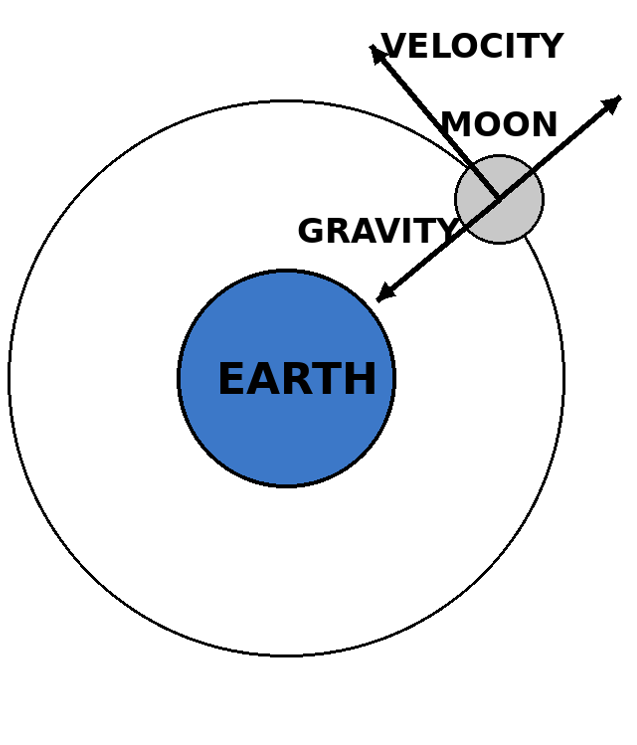
The Moon moves in a repeating path around Earth, and its changing phases return in a steady rhythm of about 27–28 days. Why does it go around Earth instead of falling straight down? Why does it not fly away? What determines that repeating cycle?
📜 Read the Story (or Listen)
Start with a scientific mystery: the Moon seems to be pulled by gravity, yet it keeps circling Earth in a stable path. Newton wondered whether the same force that pulls an apple downward also reaches all the way to the Moon.
🧩 What you will do
- Review why circular motion requires acceleration toward the center.
- Write Newton’s gravitational force law.
- Set gravitational force equal to centripetal force.
- Derive a formula for orbital speed.
- Compute the Moon’s speed using real astronomical values.
- Compute the orbital period and compare it to the observed lunar cycle.
- Explain physically why the Moon stays in orbit.
What to notice: This adventure connects the same ideas you use for motion on Earth
to motion in the sky. The Moon is not separate from physics on Earth. It follows the same rules.
🚀 Ready?
After the story, move to the activity page and let the mathematics reveal the hidden rule behind the Moon’s motion.