🔊 Listen to the story
Click Read to hear the story aloud. You can pause or stop at any time.
The Moon and the Invisible Push
Every night, the Moon moves.
Not randomly. Not drifting aimlessly. But with remarkable precision.
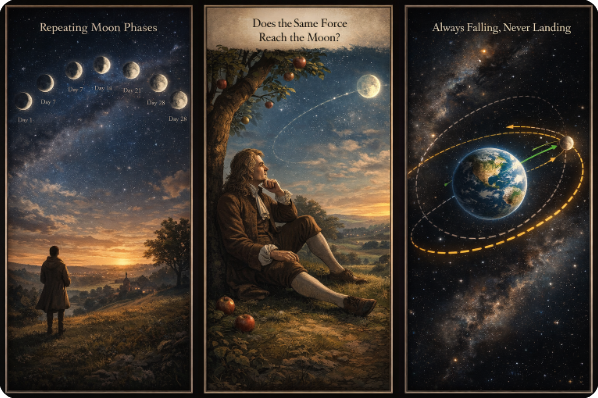
It rises, crosses the sky, and sets. Over nearly four weeks its shape changes in a repeating pattern — crescent, half, full, and back again.
This rhythm has been observed for as long as humans have watched the sky.
The question is not what the Moon does. The question is why.
On Earth, motion usually ends. A thrown ball falls. A rolling stone stops. A flying arrow eventually reaches the ground. Gravity pulls everything downward.
So why does the Moon not fall?
In the 1600s, Isaac Newton began to wonder whether the same force that pulls objects on Earth might also act on the Moon. If so, then the Moon must be constantly pulled toward Earth. But something else must also be happening, because the Moon does not crash into our planet.
It follows a curved path — steady, repeating, and predictable.
Later, physicist Richard Feynman sometimes joked that we might imagine invisible “angels” pushing objects to keep them moving. Of course, he did not mean real angels. He meant that nature behaves as if space itself contains rules that guide motion.
Today we call this idea a field — a way that space can influence how objects move.
The Moon’s changing phases reveal something important. The Moon itself does not change shape. We simply see different portions of sunlight as it travels along its path. The repeating cycle shows that the Moon’s motion is stable and precise.
If it moved faster, the pattern would change. If it moved slower, the pattern would change. Yet for thousands of years, the rhythm has remained almost the same.
Newton imagined that the Moon might be doing something extraordinary: constantly falling toward Earth while also moving sideways. Always falling. Never landing.
This idea transformed our understanding of the universe. It suggested that the same laws governing motion on Earth also govern the motion of the heavens.
But knowing that raises deeper questions. What determines the Moon’s path? What determines its rhythm? What determines its motion through space?
That is the mystery of this adventure. The sky has been repeating the same pattern for centuries. Now it is our turn to understand why.