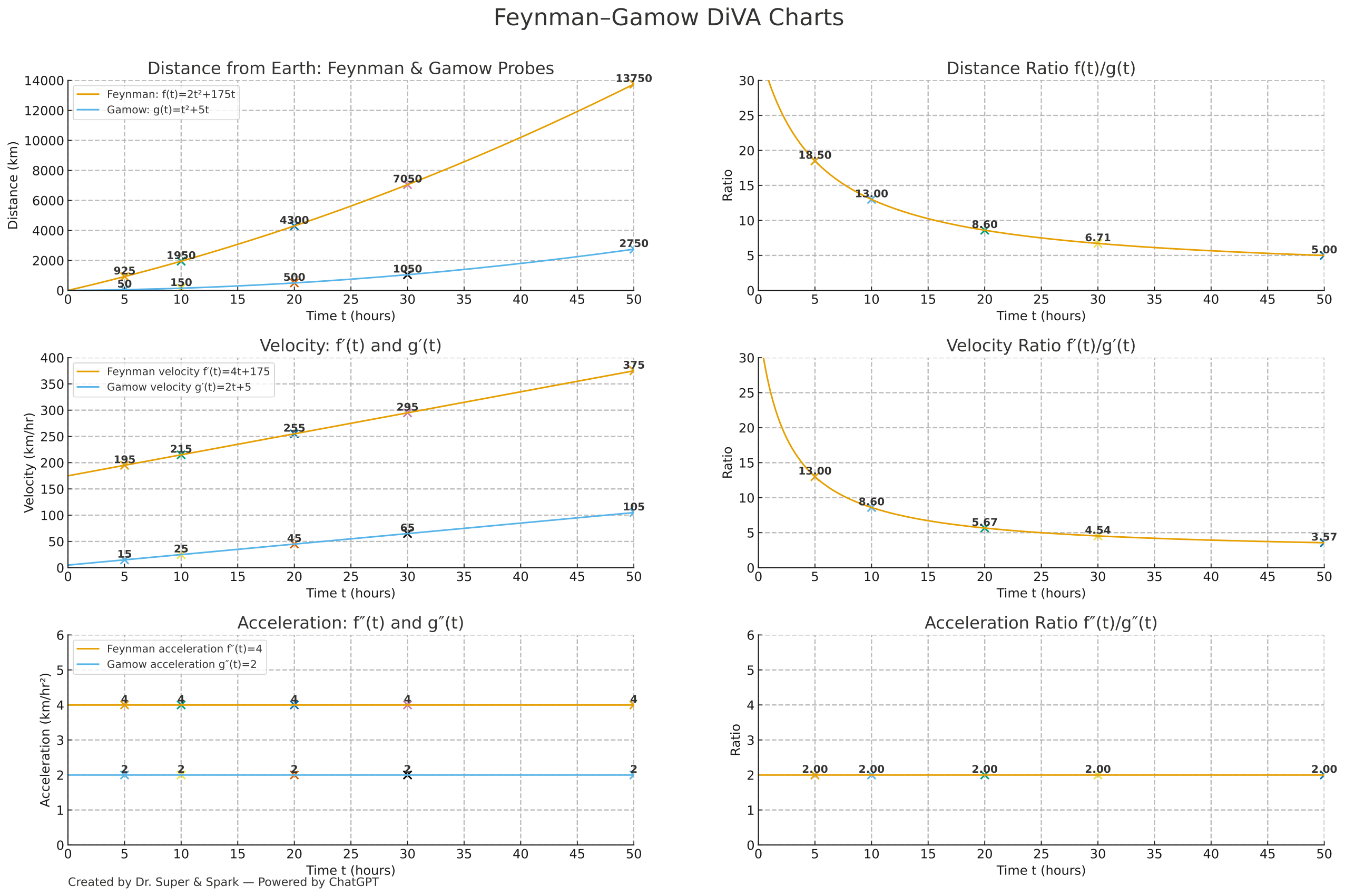
Feynman–Gamow Mission — distance, velocity, and acceleration comparisons
Use the chart to estimate values and compare the two probe distances. Close estimates are fine. Units: t in hours, distances in mission distance units.
The mission requires Feynman to stay at least twice as far from Earth as Gamow.
Use the chart and formulas to identify the velocity and acceleration functions.
Fill in the table from the chart or by calculation. Then check your answers.
| t (hours) | f(t) | g(t) | f(t)/g(t) |
|---|---|---|---|
| 5 | |||
| 10 | |||
| 20 | |||
| 30 | |||
| 50 |
What do you notice?
| t (hours) | Distance ratio f(t)/g(t) | Velocity ratio f'(t)/g'(t) |
|---|---|---|
| 240 | ||
| 720 | ||
| 1200 |
Use one or two sentences to explain why the distance ratio approaches 2.
f(t)/g(t) ≥ 2 for all t ≥ 0.f'(t)=4t+175, g'(t)=2t+5, f''(t)=4, g''(t)=2.f''(t)/g''(t)=2, and both long-time ratios approach 2.