🎯 Adventure 14 — Activity 1 (Solution)
2) Key Equations and Derivation
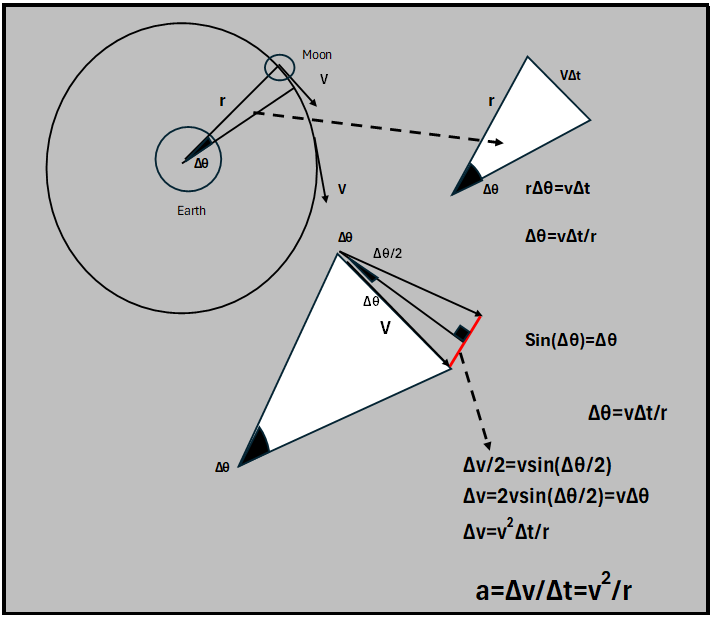
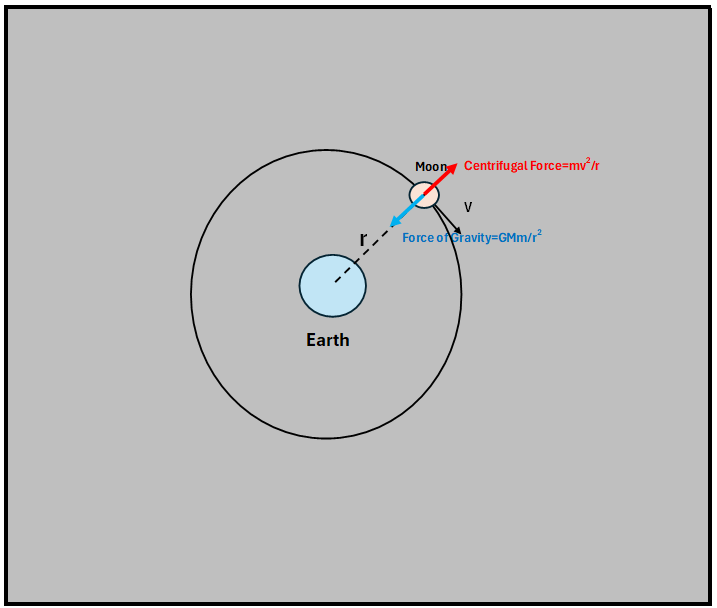
The Moon stays in orbit because gravity provides exactly the centripetal force required for circular motion.
Newton’s gravitational force: F = GMm / R²
Circular motion requirement: F = mv² / R
Set them equal:
GMm / R² = mv² / R
Cancel m and multiply by R:
GM / R = v²
Therefore:
v = √(GM / R)
3) Compute the Moon’s Orbital Speed
Using G = 6.67 × 10⁻¹¹, M = 5.97 × 1024 kg, and R = 3.84 × 10⁸ m:
v ≈ 1018 m/s
v ≈ 1.02 km/s
4) Compute the Orbital Period
Circumference:
2πR ≈ 2.41 × 10⁹ m
Time = distance / speed:
T ≈ 2.37 × 10⁶ s
Convert to days:
T ≈ 27.4 days
5) Interpretation
Why does the Moon not crash into Earth?
The Moon is constantly falling toward Earth, but its sideways velocity keeps missing Earth.
What if the Moon moved more slowly?
Its orbit would shrink and it could spiral inward.
What if the Moon moved more quickly?
Its orbit would grow larger, and if it became fast enough it could escape Earth completely.
1) The Big Idea
The Moon stays in orbit because gravity provides exactly the centripetal force needed for circular motion.